




Germany
Find the best student rooms in Germany









Things to do Germany

Student accommodation in Germany is really affordable thanks to tuition-free public universities and a growing number of residences. Whether you’re looking for a subsidised dorm or a fully furnished studio, you can find it here. Casita complements this by listing private, managed apartments close to major campuses for students arriving from abroad.
With a temperate climate, strong public transport, and a culture that balances hard work with proper downtime, Germany suits students who want serious academics without sacrificing quality of life.
Top German Universities
Technical University of Munich (TUM)
The Technical University of Munich is one of the top universities worldwide, ranking 25th in the QS World University Rankings 2027. It also ranks first in Germany, according to THE. The university has around 36,990 students, and about 37% are international students. TUM is famous for engineering, computer science, and natural sciences.
TUM has a lot of campuses around Germany and abroad, including the following:
Munich: the main campus since 1868.
Garching: the largest centre for natural sciences and engineering with major research facilities and laboratories.
Weihenstephan: green campus focused on bio- and life sciences
Straubing: It focuses on biotechnology, sustainability and bioeconomy.
Ottobrunn-Taufkirchen: It focuses on aerospace and geodesy.
Heilbronn: The education and research campus connects management, IT and technology in an innovative region.
Singapore: It is TUM’s overseas teaching campus in Singapore
Ludwig Maximilian University of Munich (LMU)
Ludwig Maximilian University of Munich is one of the top universities both worldwide and in Germany. According to the QS World University Rankings, it ranks 61st, while in Germany it ranks as the 2nd-best university in the country.
Since its founding in 1472, LMU has attracted inspired scholars and talented students from around the globe, keeping the university at the nexus of ideas that challenge and change our complex world. It excels in humanities, medicine, life sciences, and social sciences, with 28 English-taught master's programmes.
The university has many campuses, including:
Campus Geschwister-Scholl-Platz: the main campus, with humanities, cultural studies, law, economics and business.
Campus Sendlinger Tor: It focuses on medicine, clinics, geosciences, and parts of mathematics, informatics, and statistics.
Campus Großhadern / Martinsried: This campus is primarily for the natural and life sciences and is closely linked to research institutions and LMU University Hospital.
Campus Oberschleissheim: It is for the entire Faculty of Veterinary Medicine.
Humboldt University of Berlin (HU Berlin)
Humboldt University of Berlin is one of Germany’s most prestigious universities and a leading institution in Berlin. It is known for strong research and teaching in majors, such as humanities, social sciences, natural sciences, and life sciences, and it offers a wide range of degree programmes with many international options.
Founded in 1810, HU Berlin is spread across Berlin with four main campuses: Mitte, Nord, Adlershof, and Dahlem. The university has more than 300 buildings across Berlin and Brandenburg, and its campuses each have a distinct academic profile and atmosphere.
The university has many campuses, including:
Campus Mitte: the historic main campus, home to the arts and humanities, law, economics and business studies, and theology.
Campus Nord: focused on life sciences and located near Charité.
- Campus Adlershof: dedicated to mathematics and natural sciences, and located in Berlin’s science and technology district.
Best Student Accommodation in Germany
In Germany, there are a lot of student accommodation options to suit different budgets and lifestyles. Most of the main universities are well tied to student accommodation, and students can reach lectures and campus facilities on time with ease. Student accommodation will usually set you back between €350 and €600 a month, give or take the currency.
Schlüsselbergstraße, Munich: This German student accommodation offers single rooms with Wi-Fi, central heating and parking.
Toy Factory 13, Room 3 Jumbo, Munich: This accommodation for international students in Germany has a 24/7 CCTV system, and all rooms are fully furnished.
Leopoldstraße - Studio Apartment: This student housing in Germany is equipped with essential furniture such as a bed, desk, chair, and storage units.
Zürcher Straße, Munich: The student accommodation in Germany has on-site laundry facilities to wash & dry your clothes without having to leave the building.
München Trudering - MADREAM Apartment: The student accommodation in Germany has all the essentials, such as Wi-Fi, security teams, and car parking.
What Are the Most Affordable and Safest Student Accommodation Options in Germany?
Security features like CCTV, secure key-card entry, and on-site staff are increasingly standard across accommodation for international students in Germany.
Toy Factory 12 Room 3 Standard+: This accommodation for international students in Germany has 24/7 security and a CCTV system.
Toy Factory 2 Room 3 Mighty: Besides the security team in this student accommodation in Germany, it is fully furnished.
Comfort Double, Munich: This accommodation for international students in Germany offers a furnished place, Wi-Fi and a CCTV system.
Amselweg, Munich: The property is an open-air area located on the building’s roof, featuring seating, greenery, and scenic views.
Colmarer Straße, Munich: It offers single rooms with amenities, such as Wi-Fi, security teams and car parking.
Best Cities for Students in Germany
Germany is full of cities which are perfect for international students. The cities have a mix of strong universities. Pick the best city based on your budget and the vibe you want.
Munich
Munich ranks among the best student cities, with a fourth rank, according to QS rankings. The city is home to TUM and LMU. It is known for its tech and engineering scene and high quality of life. Don't miss visiting the Deutsches Museum and the sprawling Englischer Garten. Rents run highest here, but strong industry links make it worth it for STEM students.
Berlin
Berlin is also one of the best cities, with the seventh rank. It is Germany's capital and a magnet for creative, research-driven students. It is home to Humboldt University and the Free University. Highlights include Museum Island and the Staatsbibliothek. Berlin offers the widest mix of accommodation types and excellent transport links.
Leipzig
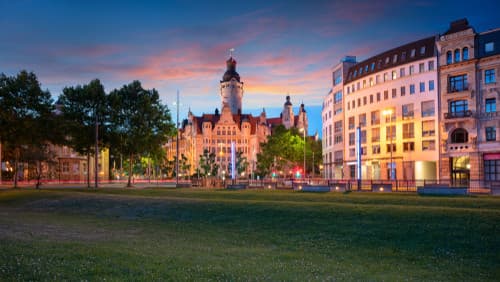
Leipzig is an affordable eastern German city with a booming startup and arts scene and is home to Leipzig University. Check out the historic Leipzig University Library and the Museum der bildenden Künste.
Cost of Living in Germany
According to Numbeo, the estimated monthly cost of living for a single person in Germany is around €1,000, excluding rent.
Student Accommodation
Item | Monthly Cost |
Shared Room (WG) | €300-€650 |
En-suite Room (dorm/private hall) | €250-€500 |
Studio Apartment | €500-€900 |
Premium Studio (branded residence) | €700-€1,300 |
Groceries
Item | Monthly Cost |
Fresh White 500 g Loaf of Bread | €1.15-€3.70 |
1 kg Tomatoes | €1.69-€4.99 |
1 kg Onions | €0.95-€2.49 |
1 L Milk | €0.99-€1.50 |
1 kg White Rice | €1.60-€4.58 |
12 Eggs | €2.39-€4.56 |
1 kg Local Cheese | €8.00-€25.00 |
1 kg Chicken Fillets | €7.00-€16.00 |
1 kg Oranges | €1.65-€4.00 |
1 kg Apples | €1.60-€3.49 |
Utilities
Item | Monthly Cost |
Basic Utilities for 85 m² Apartment | €200.00-€507.00 |
Mobile Phone Plan | €9.50-€39.95 |
Transportation
Item | Cost |
One-Way Ticket | €2.60-€4.10 |
Deutschlandticket (nationwide public transport) | €63/month (student version from €34.80/month) |
Transport & Connectivity for Students in Germany
Germany's public transport network is dense, punctual, and easy to navigate once you're set up with the right ticket.
Metro
City U-Bahn and S-Bahn networks (like BVG in Berlin and MVG in Munich) run frequently and connect directly to most campuses; most students access the whole network via their semester ticket.
Bus
Local and regional buses fill in the gaps beyond rail lines, especially in smaller university towns, and are covered by the same tickets as trains and trams. Here are some popular bus stations: Zentraler Omnibusbahnhof Berlin and Munich ZOB.
Trains
The suburbs and nearby towns are linked by Deutsche Bahn regional and S-Bahn services. Starting in January 2026, the Deutschlandticket will cost €63/month (or about €34.80/month for students via the discounted Deutschland-Semesterticket, which is included in many university fees for the winter semester 2025/26). Students can use it to travel on regional trains throughout the country.
Walking/cycling
Most German university towns are compact and bike-friendly with dedicated lanes; a second-hand bike is a smart, low-cost investment for daily commutes.
Top Student Attractions in Germany
Museum Island (Berlin): a UNESCO World Heritage site housing five major museums, from ancient antiquities to 19th-century art.
Deutsches Museum (Munich): one of the world's largest science and technology museums, a must for STEM students.
Englischer Garten (Munich): one of the biggest urban parks in the world, perfect for studying outdoors or unwinding between lectures.
Staatsbibliothek zu Berlin (Berlin State Library): one of Germany's largest research libraries, with stunning reading rooms.
Leipzig University Library: historic and modern study spaces in the heart of Leipzig's university quarter.
Museum der bildenden Künste (Leipzig): a major fine arts museum with student-friendly ticket prices.
Frequently Asked Questions
Is Germany a good place to live and study as an international student?
Yes, because Germany is one of Europe's top destinations for international students. With a record 420,000 international students enrolled in the 2025/26 winter semester.
What's the most luxurious type of student accommodation available in Germany?
These come fully furnished with all-inclusive bills, high-speed Wi-Fi, laundry facilities, and 24/7 security with CCTV; properties like München Trudering - MADREAM Apartment and Toy Factory 13, Room 3 Jumbo are good examples of this higher-end tier.
How much should I budget for student housing in Germany each month?
Most student accommodation in Germany falls between €350 and €600 a month, though this varies by room type and city. Shared WG rooms start around €300, while en-suite rooms in halls run €250-€500, studios €500-€900, and premium studios up to €1,300.
Which neighbourhoods are most popular for student accommodation in German cities?
In Munich, popular student areas are near TUM and LMU, including Schlüsselbergstraße, Zürcher Straße, and Colmarer Straße. Berlin offers diverse housing options near Humboldt University and Free University, while Leipzig's university quarter by the Leipzig University Library is an affordable choice.
How can I book a private apartment in Germany through Casita?
You can browse Casita's listings of private, managed apartments near major German campuses, compare options and book directly online.

See More Questions (5)
Directory of city names
B
F
G
H
J
K
L
M
R
S
U
W